Penn GSE · Individual course project
Recycle Right
Exploring image classification and AI literacy through everyday recycling.
01 Overview
I created an image-classification prototype in Google Teachable Machine to distinguish used paper and bottles. I developed it as a possible school recycling activity: children could predict a classification, compare it with the model’s response, and investigate surprises.
The focus is learning how examples shape an AI model and why its predictions need human judgment. This is an educational prototype and learning-design project.
The initial concept had two object categories. The documented version also includes “Blank (Nothing)” for an empty scene. My original course summary uses the working title “Recycling Detective.”
02 Training & predictions
These screenshots capture two moments in development. Open either image to inspect the training samples and prediction confidence.
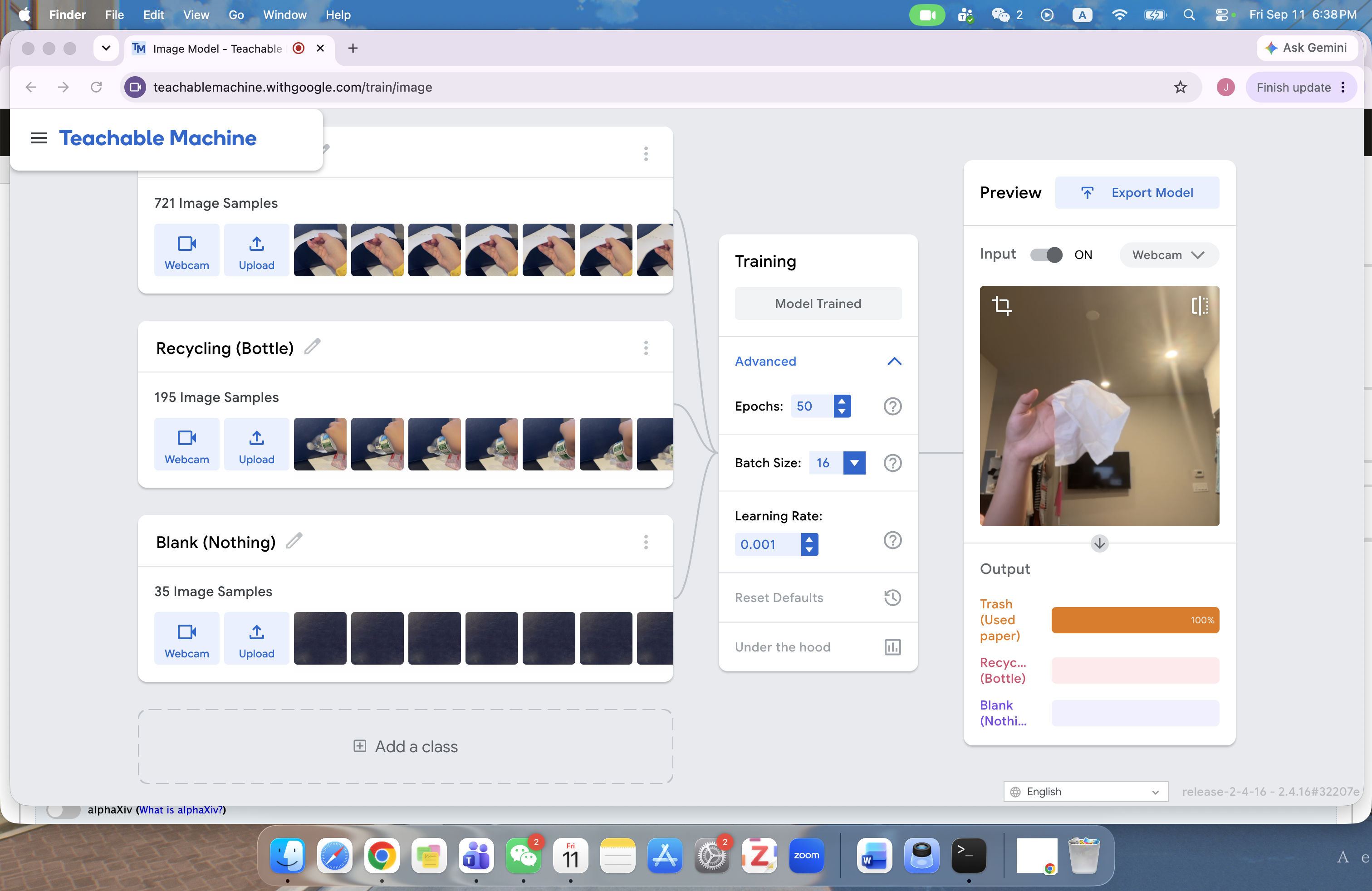
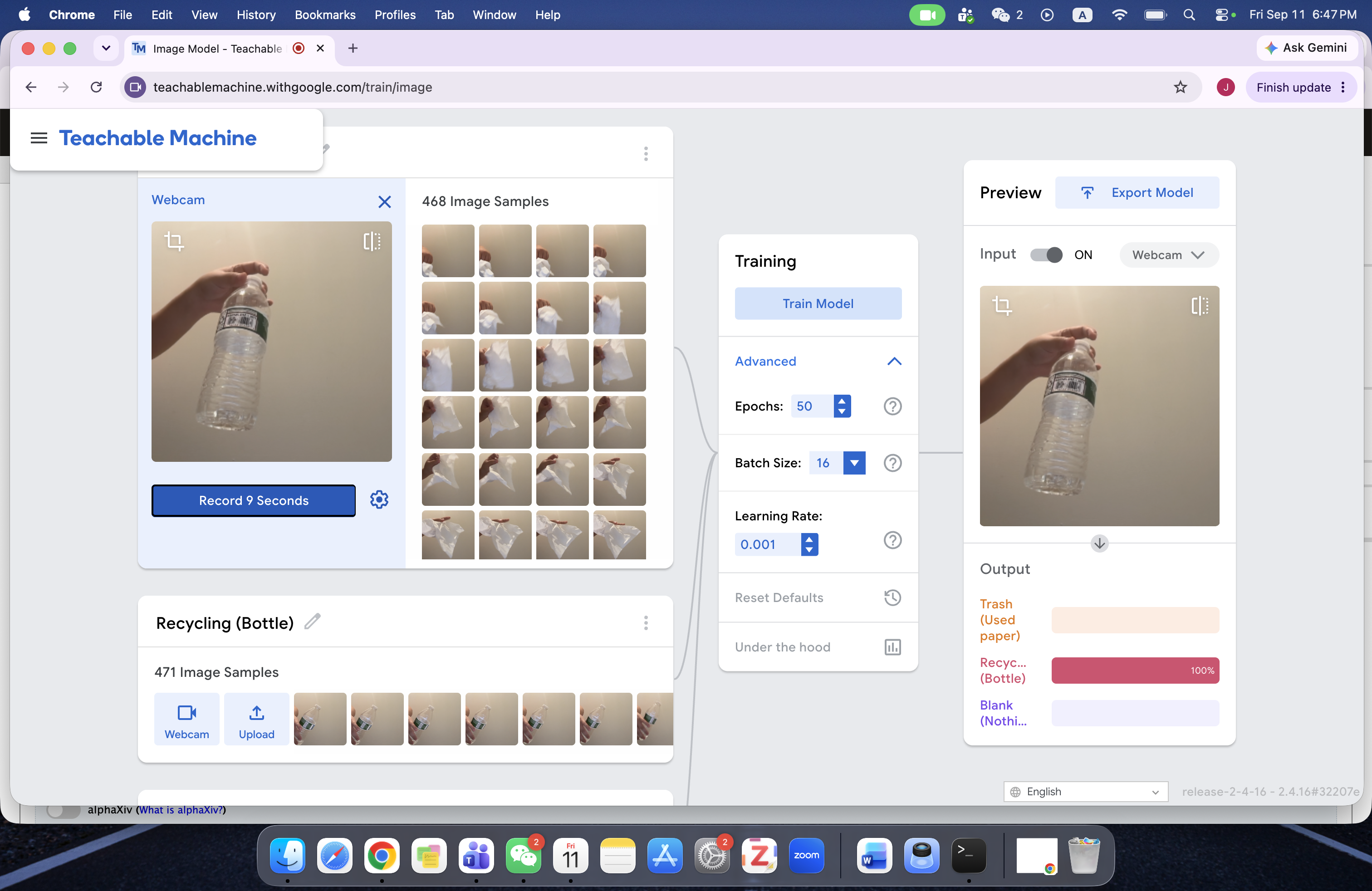
These confidence readings describe individual inputs, not measured accuracy across a test dataset. The original class labels are preserved in the screenshots; they are not recycling instructions.
“A model can be confident and still be wrong.”
03 Design & development
The process became a cycle of testing and revising the data. Expand a step to see what I did and what changed.
01Collect examples
I captured and labeled webcam images of used paper/tissue and bottles. I added a Blank (Nothing) class after noticing that the two-class model kept assigning a category even when no object was present.
02Train
I trained the labeled examples in Google Teachable Machine. My decisions about backgrounds, object size, lighting, and camera angle shaped the visual information available to the classifier.
03Test
I presented objects to the camera and watched the predictions. Early results were unstable when the objects occupied only a small part of the image; adding more images alone did not resolve the problem.
04Reflect
The white wall appeared across all three classes. I suspected that the shared background was influencing the model, rather than assuming it had learned only the objects I intended it to recognize.
05Retrain
I rebuilt the dataset with objects closer to the camera and more varied examples. Across roughly three training attempts, bottle and paper predictions became more stable, while the blank class remained less consistent.
One persistent challenge was the empty scene. In my summary, I recorded approximately 89% confidence for “Blank (Nothing)” against the white wall. The shared background was a possible explanation, rather than a verified account of which features the model used.
04 Learning design
In a classroom, children could make their own prediction before revealing the AI output, then change one condition—such as the background or camera angle—and compare again.
- Explain how supervised learning uses labeled examples.
- Notice how human choices shape the training dataset.
- Test familiar and unfamiliar examples under different conditions.
- Distinguish confidence from correctness.
- Use mistakes to revise examples and retrain.
- Evaluate AI output before acting on it.
These are intended learning goals for a possible activity; the prototype has not established classroom learning outcomes.
05 What I learned
More images did not automatically produce better predictions. The variety and quality of examples mattered: changing the object’s distance from the camera made the effect of my data choices visible.
The classifier learned statistical visual patterns from the examples I selected. It did not understand the meaning of paper, bottles, or recycling. Errors became opportunities to examine the dataset and ask what the model might be responding to.
This reflection connects with Druga and Ko’s work on children investigating machine intelligence and Marx et al.’s study of machine-learning misconceptions. For this activity, I would ask learners whether a confident result must be correct, whether testing alone changes a model, and how labeled examples differ from hand-written rules.
06 Scope & limitations
The prototype recognizes two object categories and an empty scene. A blank class is not a general “Other or Unsure” category: unfamiliar objects can still receive a confident label from the available classes.
Further development would need broader examples, deliberate testing in new settings, and a way to handle unfamiliar inputs. Any classroom recycling recommendation should encourage children to check local rules before making a final decision.
← Back to course projects